Celebrating Equality with Colorful Books
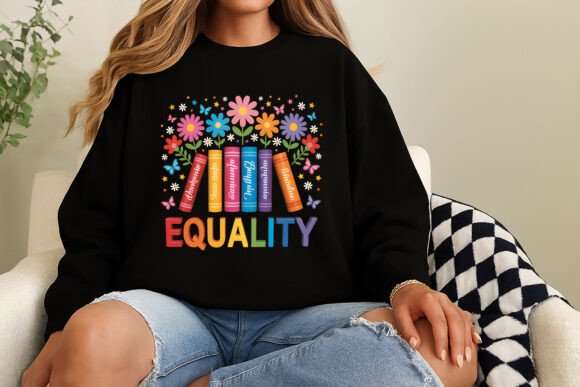
At its heart, Celebrating Equality with Colorful Books is more than a digital design—it’s a visual affirmation of inclusion, growth, and shared humanity. The image features a joyful stack of books, each rendered in a distinct, vivid hue, with delicate flowers blooming from their spines. At the base, the word “equality” anchors the composition—not as a slogan, but as a quiet, confident statement. Butterflies flutter among blossoms, and petals drift like gentle reminders: fairness isn’t static; it’s alive, evolving, and deeply rooted in diversity.
What Makes This Design Resonate?
The strength of Celebrating Equality with Colorful Books lies in its layered symbolism—accessible yet meaningful. The books represent knowledge, voice, and representation. Their varied colors reflect the spectrum of human identity: race, gender, ability, culture, and experience. The flowers rising from each spine suggest that equity doesn’t erase difference—it nurtures it. Even the butterflies echo transformation and interconnectedness, reinforcing that inclusion benefits everyone.
Technically, the file delivers professional-grade quality: a 4096×4096 pixel PNG at 300 dpi, with a transparent background. That means crisp detail whether scaled down for a notebook sticker or enlarged for a 24-inch wall print. Because it’s not editable, the integrity of the design remains consistent across uses—ideal for creators who value reliability alongside creativity.
Where This Design Truly Shines
Celebrating Equality with Colorful Books was built for versatility—and real-world application. Here’s how different users bring it to life:
- Educators and librarians use it on classroom doors, reading nook banners, or welcome posters—making “equality” a visible, everyday value for children and teens.
- Small business owners feature it on reusable tote bags, café coasters, or community event signage—communicating values without words.
- Event planners and nonprofits integrate it into Pride Month displays, school diversity weeks, or workplace DEIB (Diversity, Equity, Inclusion, and Belonging) campaign materials.
- Artisans and makers apply it to hand-painted tumblers, embroidered patches, or ceramic tile coasters—turning functional items into quiet acts of advocacy.
- Parents and caregivers print it as nursery art or birthday party decorations—introducing foundational ideas about fairness early, gently, and beautifully.
Practical Uses Across Mediums
Because the file includes a transparent background, layering is seamless. On fabric (like t-shirts or tote bags), the design holds clarity even after multiple washes—especially when printed with quality DTG (direct-to-garment) or sublimation methods. For home decor, it scales effortlessly to canvas prints, framed posters, or removable wall decals. Crafters use it for custom stationery—think greeting cards for graduations, teacher appreciation, or community awards—where warmth and sincerity matter more than polish.
It also works well in digital spaces: as a Zoom background for inclusive team meetings, a header image for nonprofit newsletters, or an Instagram Story highlight icon for organizations centered on social impact.
Who Benefits Most—and Why
This design serves people who believe in showing, not just telling. It’s especially valuable for those who want to signal alignment with equality—but without clichéd imagery or heavy-handed messaging. Teachers appreciate its age-neutral charm. HR professionals choose it because it feels uplifting, not prescriptive. Small studios and solopreneurs love that it requires zero design time—yet still conveys intentionality and care.
Importantly, Celebrating Equality with Colorful Books avoids tokenism. There are no silhouettes, no hands clasped in vague unity, no abstract gradients pretending to represent complexity. Instead, it offers specificity—books (concrete, learnable, shareable) + flowers (organic, individual, resilient). That groundedness makes it feel authentic—not performative.
Real-World Scenarios in Action
- A public library in Portland used the design on 50 reusable book bags given to summer reading program participants. Staff reported increased conversations between kids about what “equality” means—and which flower they’d “grow” from their favorite book.
- A boutique stationery brand in Austin featured it on limited-edition greeting cards for Juneteenth and International Day of Persons with Disabilities—pairing the art with short, original quotes from local authors and advocates.
- An elementary school counselor printed it on laminated placemats for lunchroom tables. Students began naming the colors and flowers during conversations about kindness and fairness—turning passive exposure into active reflection.
What to Keep in Mind
While Celebrating Equality with Colorful Books is intentionally warm and accessible, it’s not a substitute for deeper action. It won’t replace curriculum updates, policy reviews, or listening sessions with marginalized communities. Think of it as a conversation starter—not the full dialogue. Its power multiplies when paired with intentional follow-through.
Also note: colors may shift slightly depending on screen calibration or printer settings. If color accuracy is mission-critical—for example, matching a brand’s exact Pantone palette—test prints are recommended before large batches. And because the file is non-editable, customization (like adding text or swapping flowers) isn’t possible without external design tools.
Evaluating Fit for Your Project
Ask yourself three questions before downloading:
- Does this align with how your audience understands and experiences equality? If your community values subtlety and beauty over bold statements, this design fits naturally. If you need explicit calls to action or data-driven visuals, you may want supplemental assets.
- Is scalability important? With its high resolution and vector-friendly clarity, it performs well across sizes—from 2-inch enamel pins to 36-inch gallery wraps.
- Do you prioritize ease and consistency? As a ready-to-use digital file, it eliminates design delays and version-control headaches—ideal for time-sensitive campaigns or solo creators managing multiple projects.
In short, Celebrating Equality with Colorful Books meets people where they are: in classrooms, living rooms, studios, and community centers. It doesn’t shout. It blooms. And in doing so, it invites others to do the same—gently, proudly, together.