Fantasy Iridescent Background: When Soft Luminosity Meets Practical Design
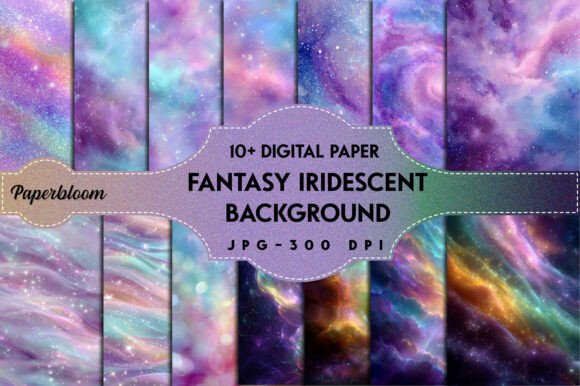
A Fantasy Iridescent Background is a digitally crafted paper texture designed to simulate the subtle, shifting play of light seen in natural iridescence—think mother-of-pearl, soap bubbles, or oil on water. Unlike flat solid colors or generic gradients, it introduces gentle chromatic transitions across hues like lavender-to-teal, rose-to-gold, or sky-blue-to-mint, all rendered with soft diffusion and surface depth. This isn’t high-contrast glitter or metallic foil; it’s a refined, luminous quality that reads as elegant rather than flashy—ideal for projects where atmosphere matters as much as clarity.
What Sets Fantasy Iridescent Background Apart From Other Textures?
Most digital paper packs fall into clear categories: solid-color sheets, distressed textures (like linen or kraft), bold patterns (florals, geometrics), or gradient overlays. A Fantasy Iridescent Background occupies a narrower, more intentional niche—it bridges the gap between background subtlety and visual interest without competing with foreground elements. Its defining traits are:
- Low-contrast color shifts: Hues blend gradually, avoiding abrupt transitions that distract from typography or layered graphics.
- Surface-level luminosity: Light appears to emanate *from within* the texture, not sit on top—as opposed to overlaying a separate shine layer, which can look artificial or inconsistent across devices.
- Print-ready fidelity: At 300 DPI and 2550 × 3300 px (8.5 × 11 inches), it retains smooth tonal gradation even when scaled or printed at full size—unlike many free low-res alternatives that pixelate or band under close inspection.
This makes it functionally different from both basic pastel papers (which lack movement) and heavily textured fantasy papers (which can overwhelm delicate layouts). It’s also distinct from animated or CSS-based iridescent effects—those require web implementation and don’t translate to print, PDFs, or physical products.
How It Compares With Common Alternatives
Choosing a background often involves tradeoffs between aesthetics, compatibility, and workflow efficiency. Here’s how a Fantasy Iridescent Background fits alongside realistic options you might consider:
vs. Solid Pastel Papers
Solid pastels offer predictability and maximum readability—especially for text-heavy pages like journal spreads or invitations. But they lack dimension. A Fantasy Iridescent Background adds quiet sophistication without sacrificing legibility, provided type contrast is maintained (e.g., dark serif fonts over a light-shift background). However, if your project prioritizes strict brand consistency—say, matching a specific Pantone—solid papers give tighter control.
vs. Hand-Textured or Scanned Papers
Scanned watercolor or handmade paper textures bring organic authenticity, but their irregularities can make alignment tricky in multi-page documents or mockups. A Fantasy Iridescent Background delivers consistent, repeatable results across files—valuable when producing series (e.g., a set of 12 monthly planner pages) or client deliverables requiring uniformity. It trades tactile realism for precision and scalability.
vs. Gradient Overlays + Blending Modes
Designers sometimes build iridescence manually using layered gradients and blending modes (e.g., Overlay or Soft Light). While flexible, this approach increases file complexity, slows rendering in apps like Photoshop or Affinity, and rarely replicates the nuanced diffusion of a professionally crafted iridescent texture. A pre-made Fantasy Iridescent Background saves time and ensures cohesion—especially for users less familiar with advanced layer management.
vs. Animated or Interactive Effects
Web-based iridescence (via SVG filters or JavaScript) responds to cursor movement or scroll position, creating dynamic engagement. But those effects vanish in static exports—PDFs, printed invitations, social media image posts, or email newsletters. A Fantasy Iridescent Background works everywhere a JPG does: in Canva, Procreate, Illustrator, Word, or even PowerPoint—no plugins or coding required.
Where It Shines—and Where It Might Fall Short
A Fantasy Iridescent Background excels in contexts where mood and refinement matter more than stark utility. For example:
- Wedding stationery: Soft shimmer complements calligraphy and botanical illustrations without competing.
- Digital planners or habit trackers: Adds visual calm to daily layouts, encouraging return use.
- Branding assets for wellness or creative businesses: Supports an ethos of gentleness, intuition, or imagination—without leaning into clichéd “magic wand” iconography.
- Social media quote graphics: Enhances emotional resonance for mindful or poetic content, especially when paired with clean, airy typography.
But it’s not universally optimal. In situations demanding high information density—such as data dashboards, technical manuals, or multilingual documents with tight spacing—a Fantasy Iridescent Background may reduce scannability. Similarly, if your design system relies on strict grid alignment or modular repetition, the subtle variation in luminance across each sheet could complicate precise tiling or edge-matching.
Also note: The pack includes nine unique variations—not infinite permutations. If your workflow requires dozens of coordinated options (e.g., for a large product line), you’ll need to supplement or adapt. And because these are JPGs—not layered PSDs or editable vectors—you can’t adjust hue saturation or lightness non-destructively after download. What you get is what you work with.
Making the Call: Is This the Right Fit for Your Project?
Ask yourself these practical questions before selecting a Fantasy Iridescent Background:
- Is the final output primarily digital or print? Since it’s delivered as high-res JPGs, it performs equally well in both—but verify your software supports importing and scaling large raster files smoothly.
- Do you value speed and consistency over granular customization? If you’re producing multiple related items (e.g., a suite of event invites, labels, and thank-you cards), having nine cohesive, ready-to-use backgrounds reduces decision fatigue and versioning errors.
- Does your audience respond to atmospheric cues? Research in visual communication suggests subtle texture influences perception of trust and care—particularly in lifestyle, education, and therapeutic niches. A Fantasy Iridescent Background supports that tone without overt messaging.
- Are accessibility considerations central? Ensure sufficient contrast between any overlaid text and the lightest/darkest points of the iridescent shift. Test with tools like WebAIM’s Contrast Checker—even if used offscreen, luminance variation affects readability.
If most answers align with “yes,” then this resource likely matches your needs. If instead you require editable layers, scalable vector fidelity, or ultra-minimalist neutrality, another category—like monochrome linen textures or parametric gradient generators—may serve better.
Final Thought: Intention Over Decoration
A Fantasy Iridescent Background works best not as ornament, but as intention made visible. It signals attention to sensory detail, a willingness to slow down visual consumption, and respect for the viewer’s emotional response to color and light. That doesn’t mean it’s always the answer—but when your goal is to evoke wonder quietly, cohesively, and reliably, it offers a rare combination of aesthetic nuance and functional simplicity.