Snowy Pine Branches Digital Paper
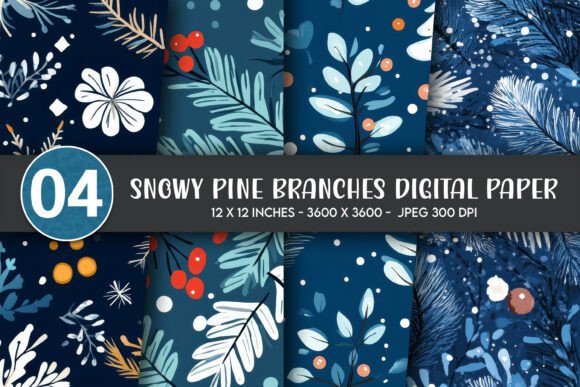
Imagine crisp winter air, the quiet hush of snow-laden evergreens, and the delicate geometry of frost-kissed pine boughs—captured not in a photograph, but as a refined, repeatable digital texture. That’s the essence of Snowy Pine Branches Digital Paper: a high-resolution, nature-inspired pattern designed with intention—not just decoration. It’s not a generic “winter background.” It’s a carefully composed visual motif: soft white snow dusting slender, slightly asymmetrical pine branches against a clean, neutral ground. The lines are organic but controlled; the contrast is gentle, never harsh. There’s warmth in its restraint, elegance in its simplicity.
More Than Just a Background—A Design Asset With Range
This isn’t a one-use pattern. Its 3600x3600 pixel size at 300 DPI means it scales beautifully—from tiny sticker die-cuts to large-format wall art posters without pixelation or loss of detail. Because it’s built on subtle tonal variation rather than bold color blocking, it works equally well as a full-bleed backdrop for greeting cards or layered softly beneath text in editorial layouts. Designers use it to add quiet sophistication to brand collateral; small business owners apply it to mug wraps and tote bag prints where texture matters more than loud graphics; crafters print it onto iron-on transfers for onesies that feel handmade, not mass-produced.
The four included JPG files give flexibility: one seamless tile for infinite repeats (ideal for web backgrounds or fabric mockups), one centered composition (perfect for framed wall decor or pillow covers), and two cropped variants optimized for vertical and horizontal orientation—so you’re not wrestling with aspect ratios when designing for Instagram posts or printable planner pages.
Where It Earns Its Place in Real Projects
In branding, Snowy Pine Branches Digital Paper functions like a quiet signature—it reinforces seasonal authenticity without leaning into cliché. A boutique candle company launching a “Frosted Fir” collection doesn’t need cartoonish snowflakes or glitter effects. This paper provides grounded, tactile credibility. On packaging, it adds depth behind product photography. On social media graphics, it serves as a consistent visual anchor across campaigns—think minimalist quote cards or limited-edition sale banners that feel cohesive, not cluttered.
For publishers and content creators, it’s a reliable base layer in editorial design: use it behind pull quotes in a holiday newsletter, as a textured header for a blog post about slow living, or as the foundation for printable journal prompts. Its even density supports readability—unlike busy patterns that compete with text, this one recedes just enough to let words breathe while still contributing atmosphere.
Practical Considerations Before You Design
Start by asking: *What role does texture play in this piece?* If your goal is clarity—say, a clear call-to-action on a digital ad—use the pattern at low opacity or only in borders. If it’s about mood—like a cozy holiday email series—go full-bleed, then overlay semi-transparent type boxes for legibility. Test contrast early: place your intended body font (especially lighter weights or thin serifs) directly over the branch detail. If letters start to visually “break up,” adjust brightness, add a subtle drop shadow, or use the centered version instead of the tile.
Pairing is intuitive but worth testing. It complements clean sans serifs (think Inter, Poppins, or Montserrat) for modern balance, and pairs surprisingly well with warm, slightly rounded scripts—just avoid anything overly ornate or tightly spaced, which can clash with the pine’s natural looseness. For print projects like mugs or throw pillows, remember that cotton and ceramic absorb ink differently than coated paper: order a physical test print first if color fidelity is critical.
Licensing That Supports Real Work
This is a commercial-use digital download—no hidden restrictions. You can license it once and apply it across unlimited personal and client projects: from Etsy shop banners and Canva templates to printed product labels and Shopify store graphics. There’s no attribution requirement, no per-project fee, and no need to track usage. What you *won’t* get is a physical item. These are digital files only—delivered instantly after purchase, ready to open in Photoshop, Illustrator, Procreate, or even Canva’s upload tool. No shipping delays. No inventory. Just design-ready texture, precisely sized and consistently rendered.
Why Resolution and Format Matter—Not Just Marketing Talk
That 300 DPI spec isn’t arbitrary. At 3600x3600 pixels, you retain sharpness when printing an 12x12 inch poster—or scaling down to a 3-inch sticker with crisp edge definition. Many “high-res” downloads stop at 2400px or use compressed JPEGs that blur fine branch details. Here, the snow texture stays granular, not smeared. And because these are JPGs—not layered PSDs or vector files—they load quickly, embed reliably in email clients, and convert cleanly across platforms without font dependencies or missing layers. You don’t need specialized software to use them. You just need a project that benefits from quiet, considered texture.
If you’ve ever spent hours adjusting opacity, masking edges, or hunting for a winter motif that feels both fresh and timeless—Snowy Pine Branches Digital Paper is the kind of asset that shortens that loop. It doesn’t shout. It settles in. And in a world saturated with visual noise, that kind of calm authority is rare—and useful.