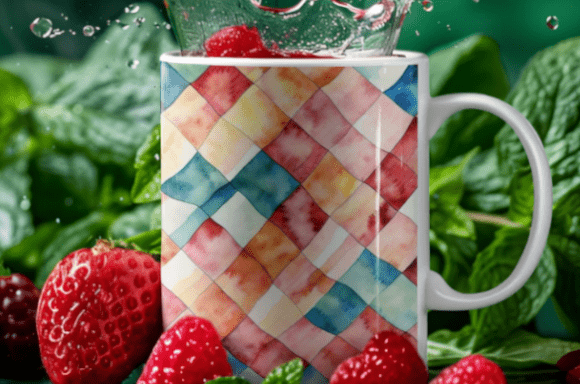
Watercolor Geometric Pattern Collection
The Watercolor Geometric Pattern Collection is a thoughtfully curated set of original surface patterns that bridges two often-opposing aesthetics: the precision of geometry and the soft unpredictability of watercolor. Unlike digitally generated vector repeats or rigid tessellations, this collection features hand-painted elements scanned at high resolution—resulting in subtle pigment blooms, gentle granulation, and nuanced edge diffusion. Each pattern maintains structural clarity through intentional shape placement (triangles, hexagons, overlapping circles, fractured grids), yet avoids mechanical uniformity by embracing organic variation in tone, opacity, and texture.
What Sets This Collection Apart
Most geometric pattern libraries prioritize scalability or symmetry over tactile authenticity. The Watercolor Geometric Pattern Collection flips that priority: its strength lies in how it preserves evidence of human gesture—slight water pooling, faint lift marks, layered washes—while still functioning as repeatable, production-ready assets. This isn’t “geometric with a watercolor filter” applied post-render. It’s geometry conceived *through* watercolor: shapes drawn with brushstrokes, not paths; grids implied by alignment, not enforced by snapping.
Consistency across the collection emerges not from identical palettes or identical spacing, but from shared principles: low-contrast transitions (no harsh edges), restrained color harmonies (often built around muted earth tones, desaturated blues, or warm greys), and rhythmic repetition that feels intuitive—not algorithmic. A triangle motif might appear in one pattern as a clustered cluster of translucent forms; in another, as staggered outlines fading into wash. Both read as part of the same family because they obey the same visual grammar.
Practical Performance Across Media
In print applications—especially textiles and wallpaper—the Watercolor Geometric Pattern Collection performs well at multiple scales. At 12–18 inches repeat, the softness prevents visual fatigue; at smaller scales (e.g., gift wrap or notebook covers), the underlying structure ensures legibility without sharpness. Because textures are embedded rather than layered as overlays, DPI scaling remains stable: a 300 dpi scan holds detail when enlarged for fabric printing, and compresses cleanly for web use without artifacting.
Digital use cases benefit from the collection’s balanced contrast. These patterns serve effectively as subtle backgrounds in presentations or UI elements where strong visuals would compete with content—unlike high-saturation or tightly packed motifs. In branding projects, they offer a distinctive middle ground: more grounded than abstract ink splatters, more expressive than minimalist line art. One designer used a softened hexagonal variant as a repeating background for an eco-conscious skincare brand’s packaging—its handmade quality reinforced sustainability messaging without literal illustration.
Usability and Workflow Integration
All patterns are delivered as seamless, tileable PNGs and high-resolution JPEGs (with transparent background options where appropriate), sized for common industry standards: 12×12 inch repeats for fabric, 3600×3600 px for large-format printing, and optimized 2400×2400 px versions for digital mockups. No vector files are included, which reflects the collection’s core identity—this is not a tool for infinite scalability, but for authentic texture-driven design.
That limitation is also its advantage. Designers report faster decision-making when working with these assets: fewer variables to adjust (no need to tweak gradient meshes or path offsets), less time spent simulating texture. A freelance stationery designer noted using three patterns from the collection across a single wedding suite—invitations, envelope liners, and thank-you cards—without needing to recolor or reposition elements extensively. The inherent harmony reduced revision rounds.
Audience Fit and Realistic Use Cases
This collection serves best those who value aesthetic cohesion *and* material honesty. Small business owners launching product lines—particularly in home goods, apparel, or artisanal packaging—find it efficient for establishing a recognizable visual language quickly. Educators creating classroom materials appreciate how the gentle geometry supports focus without distraction, while the watercolor softness adds warmth missing from stock clipart. Bloggers and content creators focused on wellness, mindfulness, or slow living often choose these patterns for headers and social media templates—they signal calm intentionality without cliché.
It’s less suited for projects requiring photorealism, ultra-bright vibrancy, or strict brand guidelines demanding absolute color accuracy across devices. Because pigments shift slightly between scans, exact Pantone matching isn’t guaranteed—though RGB and HEX values are provided for close digital approximation. Similarly, designers expecting SVG-based flexibility for responsive resizing may need to supplement with custom adaptations.
Where It Adds Long-Term Value
Unlike trend-dependent assets, the Watercolor Geometric Pattern Collection leans into enduring qualities: tactility, quiet rhythm, and compositional balance. Its patterns avoid dated stylistic cues (e.g., heavy grain filters, aggressive duotones) and instead rely on fundamentals that translate across contexts—from a linen tote bag to a PDF workbook cover. Several users reported reusing assets across unrelated client projects over 18+ months without audience fatigue, attributing this to the collection’s restraint and structural integrity.
For freelancers managing multiple clients, having a reliable set of cohesive, non-generic patterns reduces time spent sourcing or creating from scratch. One branding consultant keeps a subset of five patterns on hand specifically for mood boards—clients consistently respond to their “calm confidence,” a phrase that captures the dual nature of the work: structured enough to feel intentional, soft enough to feel approachable.
Recommendations for Effective Use
- Start with scale context: Review your primary output format first—wallpaper needs larger repeats than scrapbook paper. Match pattern size to intended viewing distance.
- Test contrast early: Overlay text or icons at actual size. Watercolor softness can reduce readability if foreground elements lack sufficient tonal separation.
- Embrace limited palettes: The collection works most cohesively when paired with typefaces and photography that share its quiet confidence—avoid pairing with bold sans-serifs or high-gloss product shots unless intentionally juxtaposing.
- Consider layering: Some users achieve depth by overlaying a light grid variant at 15% opacity beneath bolder typography—a technique that reinforces structure without competing.
Ultimately, the Watercolor Geometric Pattern Collection delivers what many creative professionals seek but rarely find: consistency without rigidity, elegance without effort, and versatility rooted in authenticity. It doesn’t try to be everything—but where its strengths align with your project’s goals, it offers tangible efficiency and quiet distinction. If your work benefits from patterns that feel both considered and human-made, this collection earns its place as a functional, repeatable resource—not just decoration.